
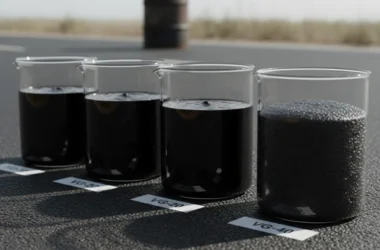
1. Bitumen (VG Grades)
VG bitumen is the backbone of most paving works. It is specified by viscosity grade because viscosity influences how the binder behaves during heating, mixing, laying, and compaction. On a busy site, the “right” VG grade is the one that helps the mix lay smoothly, compact well, and hold shape under traffic after opening.
Bitu Way supplies VG-10, VG-20, VG-30, and VG-40 for common paving works where consistency and predictable behaviour matter.
Key Applications
- Bituminous concrete works and asphalt layers
- Dense base and binder layers
- Standard road paving and strengthening works where VG grades are required by specification
Why VG Bitumen Is Important
Many road defects start from the binder not matching the job conditions. If viscosity and workability don’t align with site temperature, traffic stress, and laying method, the road may show early distress or require frequent maintenance. VG grades give engineers and contractors a practical way to select a binder that fits the expected service condition.
Benefits
- Helps achieve more consistent mixing, laying, and compaction behaviour
- Supports surface durability when matched correctly to traffic and climate
- Reduces avoidable “on-site adjustments” that slow down paving rhythm
Selection / Ordering Guidance
When enquiring, share: (1) layer type/work scope, (2) traffic intensity, (3) site temperature behaviour, and (4) project timeline. The right VG grade becomes easier to confirm when these details are clear.
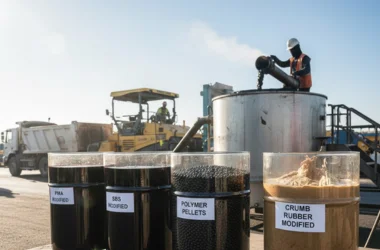
2. Modified Bitumen (PMB and CRMB)
Some stretches face stress that standard binders struggle with—heavy axle loads, braking zones, turning points, and high-temperature exposure. Modified bitumen is designed for these tougher realities.
Bitu Way supports supply of PMB (Polymer Modified Bitumen) and CRMB (Crumb Rubber Modified Bitumen) for projects where performance requirements go beyond routine paving.
Key Applications
- Heavy traffic corridors and high-stress stretches
- Rut-prone zones (junction approaches, turning lanes, slow-moving traffic areas)
- Locations where fatigue cracking risk is higher due to repeated loading
- Projects seeking longer service life with fewer repeat interventions
Why Modified Bitumen Is Important
When traffic and heat keep pushing a surface day after day, the road needs a binder that resists deformation and handles stress cycles better. That is the practical reason PMB and CRMB are chosen—not for “premium lab values”, but for reduced maintenance pressure on demanding sections.
Benefits
- PMB: Often selected where rut resistance and elasticity are important
- CRMB: Often selected where fatigue resistance and thermal behaviour matter
- Better suitability for high-stress road conditions compared to standard binders (when specified correctly)
Selection / Ordering Guidance
Tell your team’s pain point first: rutting risk, fatigue cracking risk, temperature stress, or heavy loads. Then share the road type and expected traffic pattern. That makes it easier to shortlist PMB vs CRMB in a practical way.

3. Bitumen Emulsions
Emulsions are widely used for maintenance and surface works because they make application practical across different site conditions—especially when shutdown windows are short and work has to move fast. The real success factor, however, is selecting the right emulsion type so breaking, bonding, and curing happen as expected.
Bitu Way supplies RS-1, RS-2, MS, SS-1, SS-2, CSS-1, along with microsurfacing emulsion for microsurfacing works.
Key Applications
- Tack coats and prime coats
- Surface dressing works
- Cold mix jobs and patch repairs
- Preventive renewal using microsurfacing (specialty emulsion)
Why Bitumen Emulsions Are Important
Maintenance failures often come from “bonding that looked fine on day one” but breaks down under traffic and weather. Correct emulsion selection improves the chance of clean bonding and stable performance after opening to traffic, especially in routine repair and surface treatment work.
Benefits
- Supports faster, more practical surface treatments and maintenance operations
- Suitable for varied maintenance uses (tack/prime, patching, surface dressing, cold mix)
- Microsurfacing emulsion supports grip restoration and surface sealing through microsurfacing works
Selection / Ordering Guidance
Before ordering, decide the work type clearly: tack/prime, surface dressing, cold mix/patching, or microsurfacing. Share surface condition and expected weather window. Those two inputs usually decide the most sensible grade choice.
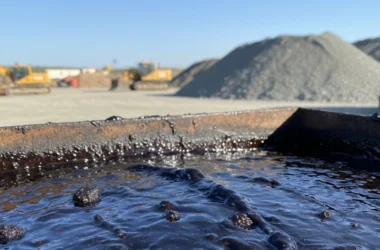
4. Dust Suppression Product (Bituminous)
Dust is not only an environmental issue — it becomes a daily operational problem on haul routes and high-traffic site roads. Visibility drops, movement slows, near-miss risk increases, and repeated watering turns into a routine cost.
Where suitable for the site condition, Bitu Way supports dust suppression requirements with a bituminous dust suppression product category, planned with practical application guidance.
Key Applications
- Tack coats and prime coats
- Surface dressing works
- Cold mix jobs and patch repairs
- Preventive renewal using microsurfacing (specialty emulsion)
Why Bitumen Emulsions Are Important
Maintenance failures often come from “bonding that looked fine on day one” but breaks down under traffic and weather. Correct emulsion selection improves the chance of clean bonding and stable performance after opening to traffic, especially in routine repair and surface treatment work.
Benefits
- Supports faster, more practical surface treatments and maintenance operations
- Suitable for varied maintenance uses (tack/prime, patching, surface dressing, cold mix)
- Microsurfacing emulsion supports grip restoration and surface sealing through microsurfacing works
Selection / Ordering Guidance
Before ordering, decide the work type clearly: tack/prime, surface dressing, cold mix/patching, or microsurfacing. Share surface condition and expected weather window. Those two inputs usually decide the most sensible grade choice.
5. Industrial Liquids (LDO, FO, MTO)
Industrial operations run on timing. When supply planning is unclear, it creates avoidable downtime risk and last-minute procurement pressure. Bitu Way supports supply requirements for LDO, FO, and MTO (as per requirement and feasibility), with a focus on coordination that keeps procurement straightforward.
Key Applications
- Industrial plants and operational premises
- Sites requiring fuel/oil supply support as part of routine operations
- Projects where documentation and delivery coordination are time-sensitive
Why Industrial Liquids Supply Is Important
For most buyers, the “product” is only half the job. The other half is predictability: the right quantity, at the right time, with clear documentation and coordination that matches site access and unloading constraints. A supply partner becomes valuable when the process stays smooth—especially during busy operating cycles.
Benefits
- Easier planning for routine operational requirements
- Better coordination and fewer last-minute disruptions (when planned in advance)
- Clear communication around feasibility, timelines, and documentation
Selection / Ordering Guidance
When enquiring, share expected quantity, desired delivery window, and any site restrictions (timing/access/unloading). That makes feasibility confirmation faster and keeps supply planning clean.

1. Metal Beam Crash Barriers
Metal Beam Crash Barriers are a road safety system designed to contain and redirect vehicles during an impact. On Indian roads, they are most critical where a small error can turn into a major crash, such as sharp curves, bridges, medians, embankments, and elevated stretches. The barrier helps absorb impact energy and guides the vehicle back towards the carriageway, reducing the chance of hitting a fixed object, falling into a drop, or entering opposite lanes.
At Bitu Way & Infrastructure LLP, we support projects with Metal Beam Crash Barriers planned for real site conditions. We focus on correct placement, continuous runs, safer end treatment planning, and site-ready installation inputs so the barrier performs when it is actually needed.
Key Applications
- Highway medians and road edges on high-speed corridors
- Curves, ramps, and approaches with run-off-road risk
- Bridges, flyovers, culverts, and elevated sections
- Embankments and steep drop zones
- Black spots and junction approaches
Why Metal Beam Crash Barriers Are Important
In many accidents, the second impact causes the most harm. A correctly planned and installed barrier reduces crash severity by controlling the vehicle path after impact and limiting dangerous cross-overs.
Benefits
- Reduces run-off-road and cross-median crash severity
- Improves safety on curves, bridges, and exposed edges
- Supports safer movement in low-visibility conditions
Selection / Ordering Guidance
When enquiring, share: (1) location type (median or edge), (2) risk details (drop, structure, opposing lane), (3) approximate length, and (4) site constraints.
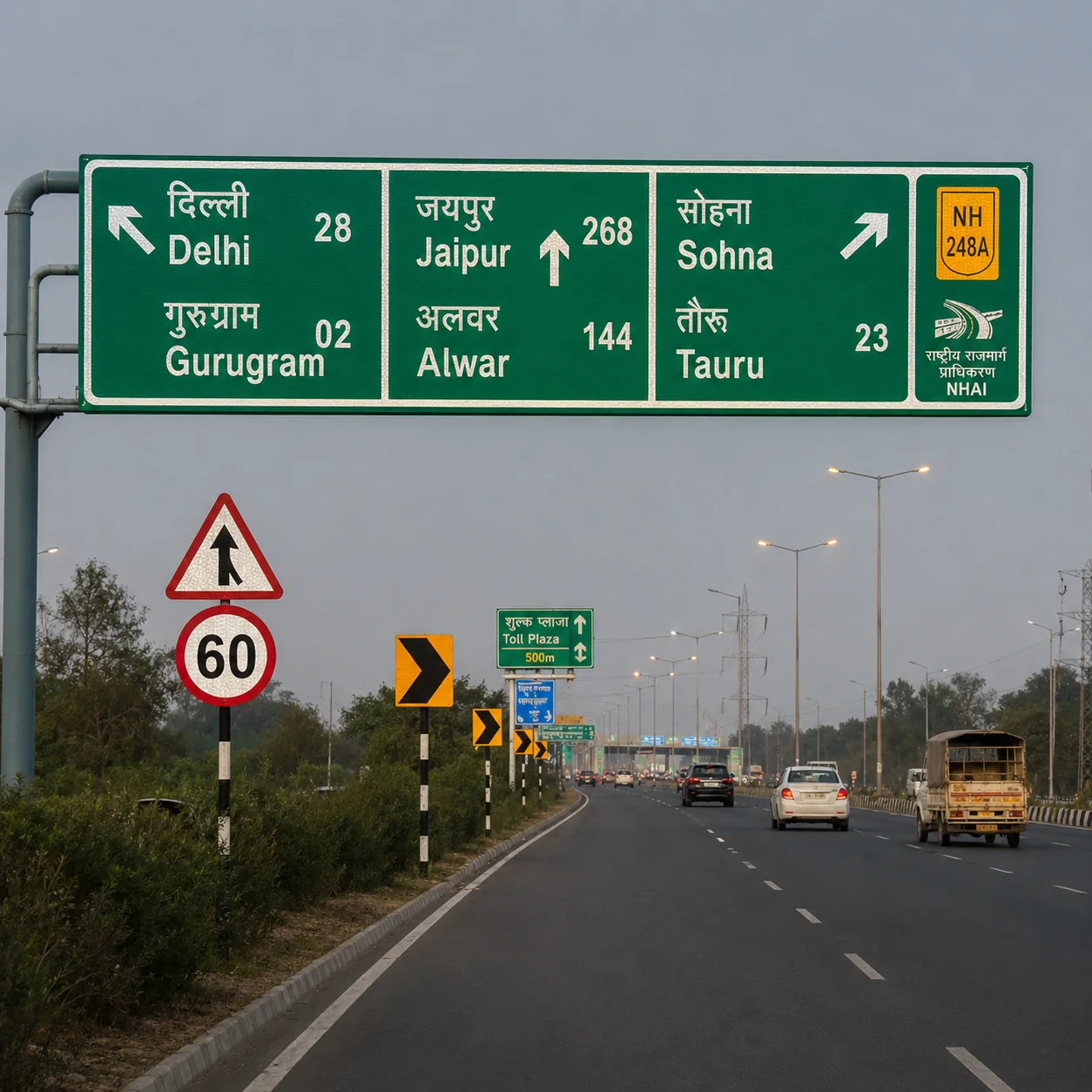
2. Retro-Reflective Signage Boards
Retro-Reflective Signage Boards are designed to give drivers clear instructions and warnings, especially at night, in rain, and in low-visibility conditions. On Indian roads, a sign is only useful if it is readable from the right distance and angle, and if it stays visible even when headlights, dust, fog, or glare make conditions difficult.
At Bitu Way & Infrastructure LLP, we support projects with retro-reflective signage boards planned for real traffic behaviour and site needs. The focus is on clarity, correct placement, and durable visibility so drivers get the message early enough to react safely.
Key Applications
- Highway signboards for directions, speed guidance, and warnings
- Junctions, curves, school zones, and accident-prone stretches
- Work zones, diversions, and temporary traffic management areas
- Industrial roads, plant premises, and logistics yards
- Parking areas and internal movement routes
Why Retro-Reflective Signage Boards Are Important
Most road incidents start with late decisions. When signs are unclear or not visible at night, drivers brake suddenly, miss turns, or make risky lane changes.
Benefits
- Improves night-time and low-visibility readability
- Supports safer speed control and lane discipline
- Reduces confusion at junctions and diversion routes
- Helps improve compliance in high-risk stretches
Selection / Ordering Guidance
When enquiring, share: (1) sign purpose (warning, regulatory, informatory), (2) location type (highway, city, industrial, work zone), (3) size requirement, and (4) quantity and installation constraints.
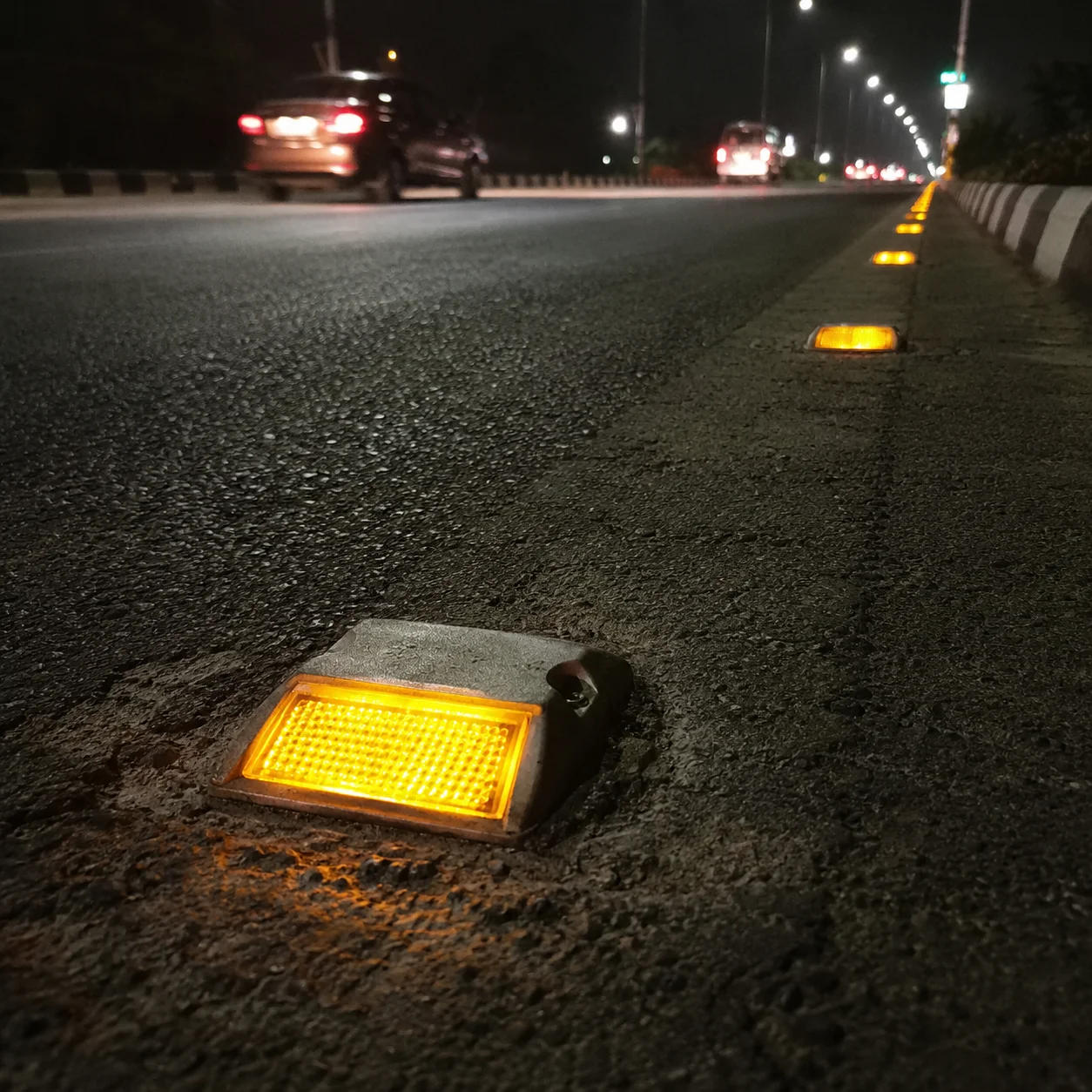
3. Road Studs / Cat Eyes
Road Studs, also known as Cat Eyes, are small but high-impact safety devices that improve lane visibility when headlights hit the road, especially at night, during rain, fog, or dusty conditions. On Indian roads, many accidents happen because drivers misjudge lane edges, curves, dividers, or sudden merges. Road studs reduce that risk by giving a clear, continuous visual guide where paint markings alone may fade or become hard to see.
At Bitu Way & Infrastructure LLP, we support projects with Road Studs selected and planned for real traffic behaviour and site needs.
Key Applications
- Lane lines, centre lines, and edge lines on highways and city roads
- Curves, ghats, bridges, flyovers, and median openings
- Junction approaches, U-turn points, and merge areas
- Work zones, diversions, and accident-prone black spots
- Industrial premises, plant roads, and logistics yards
Why Road Studs Are Important
Road studs improve driver reaction time by showing lane direction early. This helps reduce sudden braking, wrong-lane entry, and risky overtakes, particularly when visibility drops and speed judgement becomes difficult.
Benefits
- Strong night-time lane guidance and safer curve navigation
- Better visibility in rain, fog, and dusty conditions
- Reduced confusion near junctions and diversions
Selection / Ordering Guidance
When enquiring, share: (1) road type and risk points, (2) required placement locations, (3) expected traffic load, and (4) approximate quantity and installation constraints.
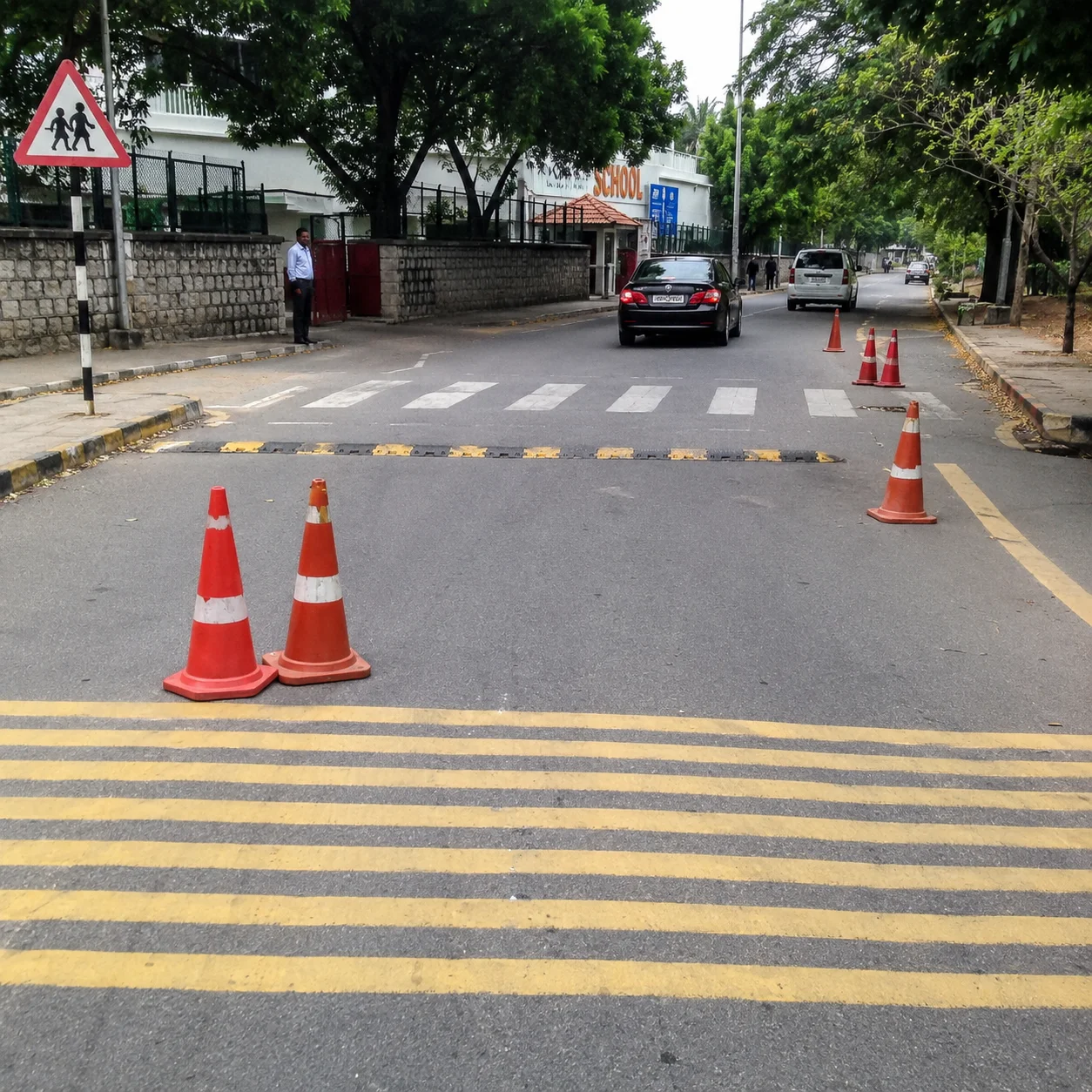
4. Rumbling Strips, Speed Breakers & Traffic Cones
Rumbling Strips, Speed Breakers, and Traffic Cones are simple traffic calming and control tools that prevent accidents by improving driver attention and reducing speed at the right locations. On Indian roads, many incidents happen because vehicles approach junctions, schools, sharp turns, or work zones too fast, or drivers realise a hazard too late.
At Bitu Way & Infrastructure LLP, we support projects with these road safety essentials planned around real movement patterns. The focus is on correct placement, spacing, and visibility so drivers react early and traffic stays organised near risk points.
Key Applications
- School zones, hospitals, markets, and residential crossings
- Sharp curves, ghats, and accident-prone stretches
- Junction approaches, U-turns, toll areas, and merging points
- Roadwork sites, diversions, and lane closures
- Industrial premises and logistics yards with heavy movement
Why They Are Important
These tools reduce overspeeding and last-second braking. Rumbling strips alert drivers through vibration, speed breakers force speed control, and cones guide traffic safely through restricted areas.
Benefits
- Better speed control at high-risk locations
- Improved work zone safety and lane discipline
- Reduced confusion in temporary traffic changes
Selection / Ordering Guidance
When enquiring, share: (1) location type and risk point, (2) traffic speed and volume, (3) length of stretch to cover, and (4) any visibility constraints.
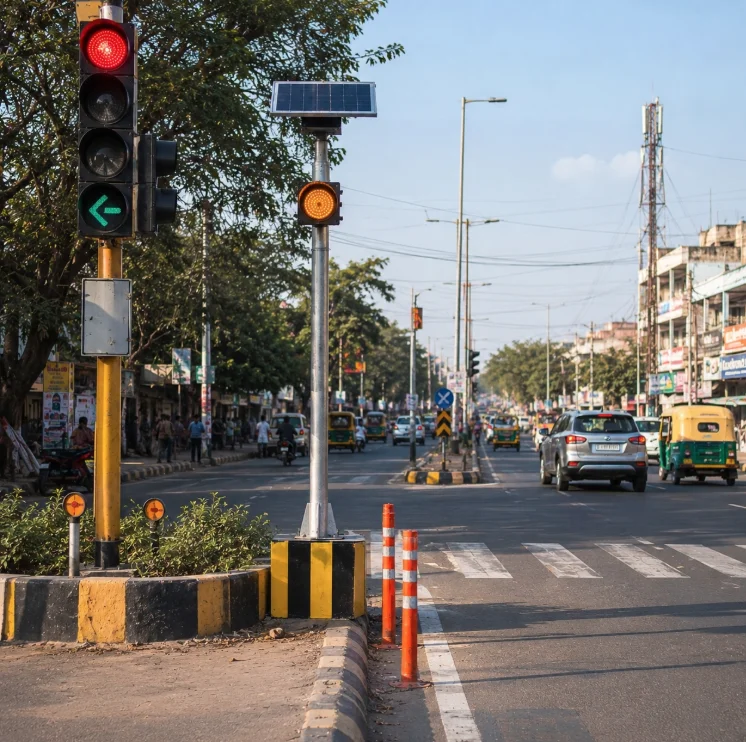
5. Traffic Lights, Solar Blinkers & Warning Lights
Traffic Lights, Solar Blinkers, and Warning Lights are used to control movement and improve driver attention at points where accidents typically happen. On Indian roads, the biggest risks come from late decisions, overspeeding near junctions, and poor visibility in the evening, rain, or fog.
At Bitu Way & Infrastructure LLP, we support projects with these safety systems planned around real site conditions. The focus is on correct placement, visibility from the right distance, and dependable operation for junctions, crossings, and work zones.
Key Applications
- Signalised junctions, crossings, and busy intersections
- School zones, hospitals, and high pedestrian movement areas
- Sharp curves, accident-prone black spots, and speed control points
- Work zones, diversions, lane closures, and temporary traffic management
- Industrial premises and logistics routes with heavy movement
Why They Are Important
Drivers react better when warnings are visible early. These systems reduce sudden braking, wrong-lane moves, and confusion at night.
Benefits
- Better traffic control and safer junction behaviour
- Improved visibility in low-light and poor weather
- Stronger warning support for work zones and black spots
Selection / Ordering Guidance
When enquiring, share: (1) location type, (2) traffic volume and risk point, (3) power availability, and (4) required visibility range and quantity.

6. Waterproofing App Membrane
Some stretches face stress that standard binders struggle with—heavy axle loads, braking zones, turning points, and high-temperature exposure. Modified bitumen is designed for these tougher realities.
Bitu Way supports supply of PMB (Polymer Modified Bitumen) and CRMB (Crumb Rubber Modified Bitumen) for projects where performance requirements go beyond routine paving.
Key Applications
- Signalised junctions, crossings, and busy intersections
- School zones, hospitals, and high pedestrian movement areas
- Sharp curves, accident-prone black spots, and speed control points
- Work zones, diversions, lane closures, and temporary traffic management
- Industrial premises and logistics routes with heavy movement
Why They Are Important
Drivers react better when warnings are visible early. These systems reduce sudden braking, wrong-lane moves, and confusion at night.
Benefits
- Better traffic control and safer junction behaviour
- Improved visibility in low-light and poor weather
- Stronger warning support for work zones and black spots
Selection / Ordering Guidance
When enquiring, share: (1) location type, (2) traffic volume and risk point, (3) power availability, and (4) required visibility range and quantity.